 Skip to content

Leasing Agent vs Real Estate Agent: Key Differences
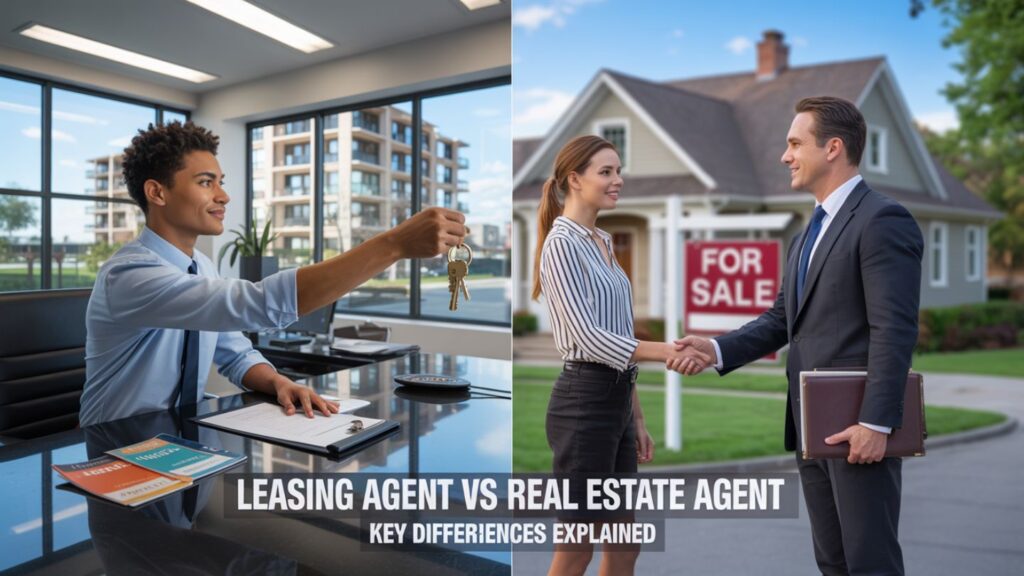
Choosing between becoming a leasing agent or a real estate agent is one of the first major decisions you’ll make when entering the real estate industry. While both roles involve working with properties and clients, their responsibilities, income structures, licensing requirements, and long-term career paths differ significantly. Understanding these differences can help you align your choice with your financial goals, risk tolerance, and professional ambitions, whether you prefer rental-focused work or broader sales opportunities.
Key Takeaways
- Leasing agents focus exclusively on rental properties, apartments, condos, and single-family rentals, while real estate agents handle both rentals and property sales, offering a broader scope of work.
- In many states, leasing agents can qualify with fewer education hours and a faster licensing timeline (as few as 15 hours and 2–4 weeks in Illinois) compared to full real estate agents or brokers.
- Real estate agents typically have higher earning potential through percentage-based commissions on property sales, but their income can fluctuate significantly based on market conditions and deal flow.
- Leasing agents often enjoy more predictable income via salary-plus-bonus structures, though their earning ceiling is generally lower than sales-focused agents.
- The right choice depends on your goals: quick industry entry and rental specialization versus broader career options and higher long-term income potential.
What Does a Leasing Agent Do?
A leasing agent is a rental-focused real estate professional who specializes in marketing vacancies and placing tenants in residential or commercial rental properties. Their work centers on prospect engagement, tours, lease execution, and move-in coordination.
Understanding the responsibilities and skills of a leasing agent is essential before choosing this path. Strong communication, organization, follow-up discipline, and customer service instincts are foundational. Leasing agents must confidently explain lease terms, highlight property amenities, and guide applicants through screening and approval processes.
Once the lease is signed and the tenant moves in, many leasing agents’ responsibilities are largely complete, unless they also hold a property management role that extends into day to day operations. This transactional approach distinguishes them from a full service property manager who handles ongoing maintenance, rent collection, and tenant relations.
To advise landlords and renters correctly, leasing agents must understand local rental markets, fair housing rules, and basic landlord-tenant laws. This knowledge helps them screen applicant backgrounds effectively, highlight relevant amenities during showings, and secure qualified current tenants who are committed to the lease agreements they sign.
Leasing Agent Licensing & Requirements
Licensing rules for leasing agents vary by state, which is an important factor to consider when planning your career path. In Illinois, for example, aspiring leasing agents must complete just 15 hours of pre-licensing education, pass a state-specific leasing agent exam, and work under a licensed managing broker. This allows for rapid entry into the field, often within 2–4 weeks.
Common baseline requirements across states include:
- Being at least 18 years old
- Holding a high school diploma or equivalent
- Completing state-approved pre-licensing education
- Passing a written exam (if the state requires a leasing license)
Unlike a property manager, whose duties extend into maintenance oversight and long-term operations, leasing professionals focus primarily on occupancy. Knowing what sets apart a leasing agent from a property manager helps clarify that leasing is transaction-driven, while management is operations-driven.
Leasing agents also encounter operational concepts like unit readiness and turnover timelines. For example, understanding what a punch list in real estate is, a checklist of repairs or final touch-ups before a unit is move-in ready, helps leasing agents coordinate with maintenance teams and set accurate expectations with incoming residents.
Pros and Cons of Being a Leasing Agent
Choosing a leasing career involves weighing several factors that affect your professional and personal life. Here’s a balanced look at what you can expect.
The advantages of becoming a leasing agent are significant for those seeking quick entry into real estate. The licensing process takes weeks instead of months, with lower upfront education costs compared to sales licensing. Leasing agents benefit from steady demand in rental-heavy markets like urban centers and college towns, and the workflow tends to be predictable, tied to leasing cycles and seasonal move-in patterns. Because leasing is customer-facing, preparation for interviews matters. Mastering tips for a successful interview in apartment leasing, such as demonstrating strong closing skills, professionalism, and knowledge of fair housing, can significantly improve your hiring prospects.
The disadvantages center on scope and earning potential. Leasing agents work primarily with rentals, limiting their involvement in higher-value sales transactions. The income ceiling is lower compared to agents who sell properties, and earnings often depend on volume, signing multiple leases to boost compensation. Without upgrading to a sales-focused license, long-term career paths may feel limited. Consider whether you prefer a customer-service, high-contact role over longer, more complex sales transactions before committing to this path.
What Does a Real Estate Agent Do?

A real estate agent (or salesperson) is a licensed professional who represents buyers, sellers, landlords, or tenants in property transactions. Their scope extends beyond rentals to include property sales, making them versatile professionals in the real estate market.
Terminology can be confusing. In many states, the public says “real estate agent,” but the license may legally be called “salesperson” under a supervising broker. In some states, “broker” is the first level of licensure. Real estate brokers can operate independently or supervise other agents, depending on state regulations.
Because first impressions matter in sales, understanding what you should wear to a real estate interview reflects the professional branding expected in this field. Real estate sales are relationship-driven, and presentation plays a role in establishing trust.
Agents also benefit from structured preparation before entering the industry. Knowing how to successfully prepare for a real estate job interview, from researching brokerages to understanding commission splits and training models, helps candidates evaluate the right firm for their goals.
Real Estate Agent / Broker Licensing & Requirements
U.S. licensing is state-specific, but most states require substantially more education for sales or broker licenses than for leasing-only roles. Understanding these requirements helps you plan your investment of time and resources.
Common steps to becoming a licensed real estate agent include:
- Meeting minimum age requirements (typically 18 or 19)
- Holding a high school diploma or equivalent
- Completing 60–90+ hours of pre-licensing education depending on the state
- Passing a comprehensive national and state exam
New agents typically must work under a managing or principal broker for a set period, often 1–3 years, before qualifying for a higher-level broker license that allows them to run their own brokerage. In Illinois, aspiring agents complete around 75 hours of pre-licensing coursework and can achieve active licensure within 2–4 months, depending on study pace.
Continuing education is mandatory for license renewals, which occur every 2–4 years. States require ethics courses, legal updates, and practice-focused training determined by each state’s real estate commission. This ongoing education ensures agents stay current with contracts, pricing regulations, and fair housing laws.
Pros and Cons of Being a Real Estate Agent
Entering real estate sales offers distinct opportunities and challenges that differ significantly from leasing-focused roles.
The advantages of becoming a real estate agent include significantly higher income potential through percentage-based sales commissions (typically 5–6% of transaction value, split between agents). Agents can work on both sales and rentals, creating flexibility in how they build their business. Career paths extend to team leader, broker-owner, or real estate investor. The schedule offers autonomy, with control over marketing, client strategy, and business development. Top producers may earn six figures or more, making this an attractive option for ambitious professionals.
The disadvantages require honest consideration. The licensing process takes longer and costs more than leasing certification. Income is irregular, tied to market conditions and closing timelines. Agents handle self-employment taxes and business expenses, from marketing to accounting to professional development. Building a sustainable client base requires consistent lead generation, and many new agents earn modest income in their first 1–2 years while developing their pipeline. Assess your risk tolerance, savings, and willingness to work commission-based before pursuing this path.
Leasing Agent vs Real Estate Agent: Side-by-Side Comparison
Understanding the key differences between these roles helps you decide which fits your strengths and goals. Here’s a direct comparison across the categories that matter most.
Scope of Work
Leasing agents focus on marketing rental properties and placing tenants, handling property showings, processing tenant applications, and finalizing lease agreements. Real estate agents can handle rentals plus property sales, investment properties, and sometimes commercial transactions. This broader scope means real estate agents work with buyers, sellers, and renters across multiple transaction types.
Licensing & Education
Leasing specialists (where separately licensed) usually complete fewer mandated hours and simpler exams. In Illinois, that’s 15 hours versus 75 hours for a full broker license. Real estate agents must pass more comprehensive exams and often complete additional post-licensing education. The difference in preparation time, weeks versus months, is substantial.
Earning Potential
Leasing agents often earn a combination of salary and smaller commissions or bonuses on signed leases, with annual earnings ranging from $30,000 at entry level to $75,000+ with experience. Real estate agents rely heavily on percentage commissions from property sales, resulting in higher potential income ($50,000–$120,000+ annually) but greater fluctuations based on market conditions and personal performance.
Client Relationships
Leasing involves shorter, transactional relationships, quick placement, then hand-off to property management for ongoing duties. Real estate sales create longer, consultative relationships where agents support clients for months and build repeat and referral business over years.
Lifestyle & Schedule
Leasing agents typically have more predictable hours tied to showings and leasing seasons, often during daytime and early evening. Real estate agents frequently work evenings and weekends, with schedules dictated by client availability, open houses, and closing deadlines.
| Category | Leasing Agent | Real Estate Agent |
| Focus | Rentals only | Rentals and sales |
| Education (IL) | 15 hours | 75 hours |
| Income Structure | Salary + bonuses | Commission-based |
| Timeline to License | 2–4 weeks | 2–4 months |
| Client Contact | Short-term | Long-term |
Career Progression: Moving From Leasing Agent to Real Estate Agent

Many professionals enter real estate through leasing roles to gain experience and then upgrade to a full real estate sales or broker license as their goals evolve. This progression offers a practical path for those who want to test the industry before committing to more extensive licensing.
Time spent as a leasing agent builds valuable skills that transfer directly to sales transactions. You’ll develop expertise in client communication, conducting property showings, understanding basic contracts, and learning local market dynamics. These foundations make the transition to sales smoother and more confident.
A typical upgrade path involves continuing to work in leasing while enrolling in state-approved pre-licensing courses for sales or broker certification. Once you complete the required education hours, you sit for the state exam. Many professionals manage this while maintaining their current income, reducing financial risk during the transition.
The practical benefits of this progression are significant. You earn steady income while studying, test your interest in real estate as a long-term career, and build a network of landlords, renters, and vendors who may become future clients. Most property owners and property managers appreciate agents who understand both sides of the rental and sales business.
After obtaining a sales or broker license, former leasing agents can continue handling rentals while gradually adding buyer and seller clients. This diversification increases earnings potential and creates multiple income streams across different market conditions.
Is It Better to Start as a Leasing Agent or a Real Estate Agent?
The best starting point depends on your personal situation rather than a one-size-fits-all rule. Both paths lead to rewarding careers, the difference lies in your resources, timeline, and long-term goals.
Starting as a leasing agent makes sense when you have limited savings, want quick entry into the industry, prefer a more structured role with predictable income, or want to work primarily with renters in dense rental markets. The lower licensing requirements and faster timeline reduce upfront risk while letting you learn the fundamentals of property management duties and tenant relations.
Jumping straight into a real estate sales license is preferable if you have a strong financial cushion, high income aspirations, willingness to handle more complex transactions, and readiness to treat real estate as a full-time entrepreneurial business. This path suits those comfortable with commission-based income and willing to invest in marketing and lead generation from day one.
Consider local market conditions when deciding. If your area has heavy rental demand, urban centers, college towns, or markets with high millennial and Gen Z renter populations, leasing offers consistent opportunities. Strong home-buying activity may favor a sales focus from the start.
Map out a 3–5 year plan. Do you ultimately want to manage your own team or brokerage? Invest in properties yourself? Remain in a client-service role? Choose a starting path aligned with that vision, knowing you can adjust as you gain experience.
How to Choose the Right Path for You
Both leasing agents and real estate agents can build rewarding, long-term careers in the real estate market. The best fit depends on your talents, finances, and tolerance for risk.
Assess your strengths honestly. Do you thrive in customer service roles with fast-paced, high-volume interactions? Leasing may be ideal. Do you prefer longer sales cycles, negotiation, and strategic marketing? A sales focus likely suits you better. Neither is inherently superior, they require different skill sets and temperaments.
Factor in financial reality. Review your savings, need for stable versus variable income, and capacity to invest in licensing, marketing, and ongoing lead generation. If you need predictable paychecks while building your career, leasing’s salary structure offers security. If you can weather slow months in exchange for higher commission potential, sales may be worth the risk.
Practical next steps to help you decide:
- Talk to local professionals in both roles about their day-to-day work and earnings
- Review your state licensing commission website for up-to-date requirements
- Attend local real estate or property management networking events
- Shadow a leasing agent and a sales agent to see both roles in action
- Contact brokerages to learn about their training and support for new agents
Whichever starting point you choose, skills and licenses can be upgraded over time. Careers in real estate are flexible rather than fixed, your initial choice doesn’t lock you into a single path forever.
Final Thoughts
Choosing between a leasing agent and a real estate agent comes down to your goals, financial preferences, and long-term vision. Leasing offers faster entry, structured income, and a rental-focused career path, while real estate sales provides broader opportunities and higher earning potential with greater income variability. Both paths build valuable industry skills, and many professionals transition from leasing into sales over time. The key is selecting the option that aligns with your risk tolerance, income needs, and professional ambitions.
If you’re exploring leasing agent jobs in Atlanta, OnSite Property Solutions connects motivated candidates with leading property management companies throughout Georgia. Whether you’re seeking entry-level leasing roles or long-term career growth, explore current openings at leasing consultant jobs in Georgia, learn more about specialized leasing consultant staffing, or visit us to connect with a recruiting team that understands the local market. Your next opportunity in real estate could be one click away.
Frequently Asked Questions
Can a leasing agent become a real estate agent without starting over?
In most states, leasing experience does not replace formal pre-licensing education for a real estate sales or broker license. You’ll need to complete the full education hours and pass the real estate exam. However, your prior work makes coursework and exams easier because the concepts are familiar. Many former leasing agents find they can build a client base faster once licensed, leveraging relationships with landlords and tenants they’ve already established.
Do leasing agents always need a license?
Many states require anyone who shows properties, negotiates leases, or collects rent on behalf of others for a fee to hold some form of real estate or leasing license. However, a few states have narrow exceptions, for example, on-site employees of a building owner performing limited tasks may not need licensing. Always check your state’s real estate commission or department of professional regulation for current requirements before starting work.
Who earns more on average: leasing agents or real estate agents?
Real estate agents generally have higher earning potential because they earn commissions on property sales, which are larger transactions than leases. Sales agents may earn $50,000–$120,000+ annually, while leasing agents typically earn $30,000–$75,000 depending on experience and market. That said, leasing agents often have more predictable income, while sales agents experience both strong earning years and slow periods based on market conditions.
Can one person work as both a leasing agent and a real estate agent?
Yes. Many real estate agents handle both rentals and sales, especially early in their careers, as long as they hold the appropriate license required by their state. In markets where a separate leasing license exists, some professionals maintain both roles, using leasing to generate steady income and leads while building a sales-focused business. This hybrid approach helps manage income fluctuations while expanding your client base.
Is the job more stressful as a leasing agent or as a real estate agent?
Leasing can be stressful during peak seasons due to high volume and tight move-in timelines, but transactions are relatively simple and shorter in duration. Real estate sales roles can be more stressful financially and emotionally because of large sums involved, longer transaction timelines, complex negotiations, and the pressure of commission-based income. Consider your stress tolerance and whether you prefer many quick transactions or fewer, higher-stakes deals.
About The Author
